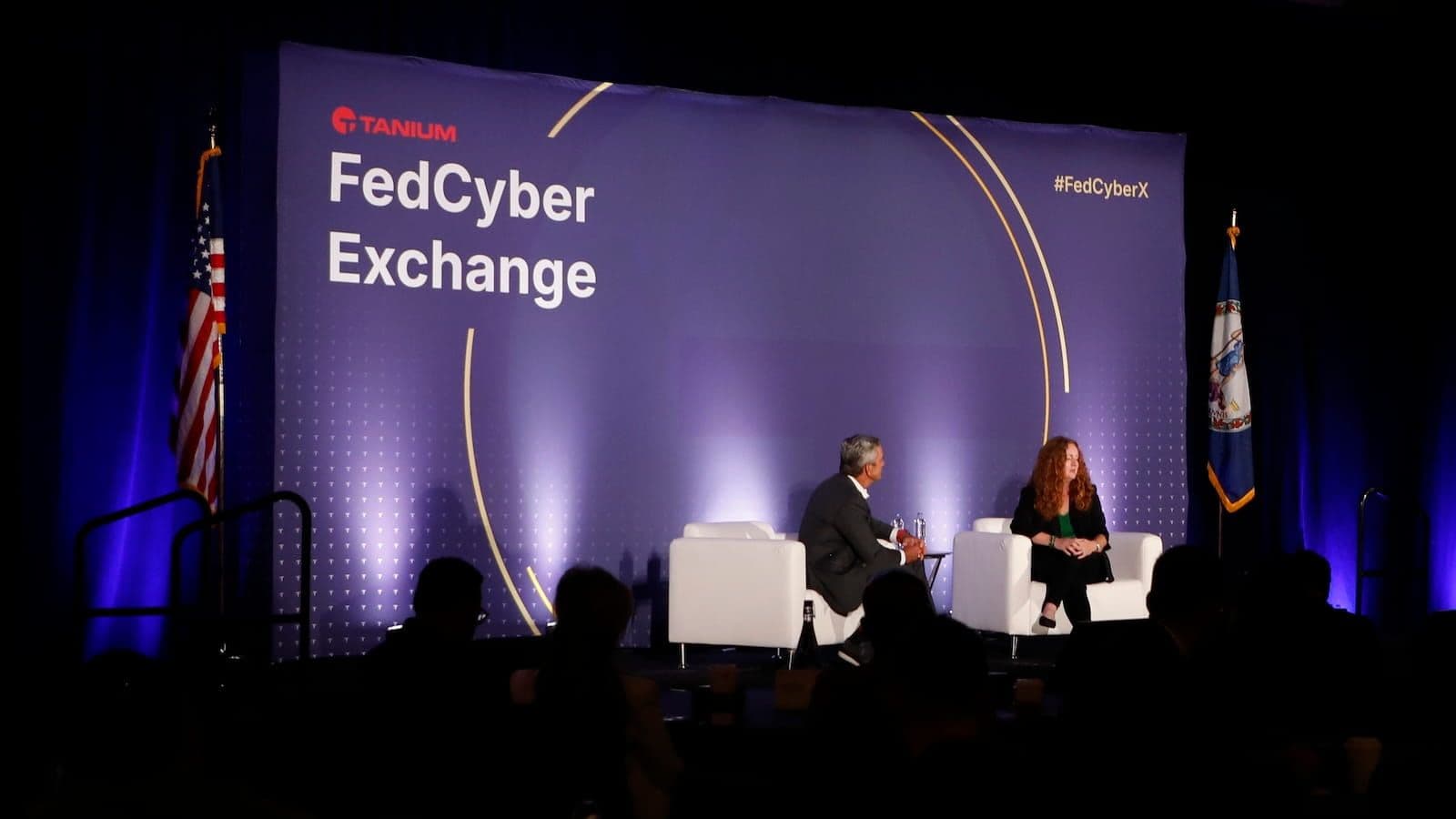
The fourth annual FedCyber Exchange recently wrapped in Tysons Corner. I walked away with a full notebook and a renewed sense of the impact autonomy and AI will have on federal agencies—not in theory, but in practice. This wasn't a conference of aspirations, it was a room full of operators, CISOs, CIOs, and other technologists actively doing the work of making their organizations unstoppable. With more than 100 customers, prospects, and partners in the room, the conversations on stage and off were sharper, more grounded, and more urgent than ever.
FedCyber Exchange is the annual cybersecurity conference hosted by Tanium, and our CEO, Dan Streetman, kicked off the April 21 event with an opening address about the challenges federal agencies face.
“Your responsibility has never been greater,” he said. “IT and security teams are expected to respond to threats, exposures, and issues at machine speed. That's the reality of your mission. Being unstoppable means more than preventing outages. It means accelerating the speed at which we adapt and innovate.”
Here are my 10 takeaways from the day, blending what I heard from the stage, what I picked up in the hallways, and what Tanium’s partnership with government agencies tells us about the direction of federal IT is trending.
1. Everyone is asking the wrong question about AI
Will AI help defenders protect networks, or will AI help adversaries attack them? The answer is: both. AI will help everyone be better and faster. AI will improve threat detection, accelerate remediation, and compress decision cycles, but it will also make adversaries more productive, more creative, and harder to detect.
The real question, the one federal IT leaders should be losing sleep over, is “Who will leverage AI more effectively?” The organizations that win won't be the ones who waited for certainty about AI risks, they'll be the ones who built the data infrastructure, governance frameworks, automation muscles, and oversight controls needed to deploy AI with confidence before the threat environment demanded it.
Automation is only as trustworthy as the data that drives it. If you want AI to help you act with certainty, you need real-time endpoint truth, not stale records and assumptions.
2. Reframing the tension between compliance and resilience
The opening fireside chat between Dan Streetman and Jennifer Gase, Deputy CISO for the CIA, was the kind of conversation you don't summarize, you absorb. Gase drew a sharp and important line between organizations that focus solely on compliance and those that are engineered to withstand disruption.
Compliance-focused organizations are built for audits. Resilience-focused organizations are optimized for mission continuity when things go wrong, and things inevitably go wrong. In the federal context, that distinction has life-and-death operational implications. Compliance is the Industrial Age approach. Resilience is the Information Age outcome for mission continuity.
<blockquote>Resilience-focused organizations are optimized for mission continuity when things go wrong, and things inevitably go wrong.</blockquote>
The best cyber defenses aren't built around what matters to auditors, but around what matters to adversaries.
3. Zero trust is no longer a strategy slide. It's real.
Zero trust has been in every federal PowerPoint deck for the better part of a decade. What was different at FedCyber Exchange 2026 was the tone. “Never trust, always verify” isn't a planning conversation anymore. The practitioners in the room weren't asking whether to execute zero trust. They were asking how to sequence it, how to sustain it under operational tempo, and how to generate defensible evidence for oversight bodies without adding manual burden.
And agencies are making progress. They’re measuring maturity; sequencing implementation across endpoints, identity, and networks; and demonstrating progress against real mandates. This all derives from the growing understanding that real-time endpoint visibility and automated policy enforcement are what make that possible, not point-in-time scans and manual reporting.
“Zero trust is a continued objective of ours,” said Nick Polk, Branch Director for Federal Cybersecurity at the White House Office of Management and Budget. “It shouldn't be about paperwork. It's all about implementation that's on the ground.”
4. Tanium Atlas is the rocket ship accelerating AI-based security
One of the most forward-looking conversations at FedCyber 2026 was about Tanium Atlas, and the energy in the room was unmistakable.
Atlas is an Autonomous Operating System interface, built on top of the Tanium platform. You describe what you need in plain language, and Atlas doesn't just give you an answer, it gives you a plan and the power to execute, right there, without leaving the conversation. Every Tanium capability, inventory, threat response, patching, exposure management, security operations, is reachable through a single natural-language interface.
Operators stop navigating between tools and start navigating between problems.
The shift is architectural and cultural. For federal IT teams managing hundreds of thousands of endpoints across dozens of locations, with bandwidth constraints, disconnected networks, and zero tolerance for downtime, the difference between "find the right tool, build the right query, pivot to remediation" and "ask, get a plan, approve, act" is not abstract. Atlas surfaces live endpoint intelligence, not stale reports, and when action is required, it presents the plan and waits for your approval before anything runs. Speed at scale, with the human always in the loop.
It also broadens who can operate effectively. Atlas lowers the training threshold for frontline teams. You don't need to know which module handles what, or which query language applies to which problem. When leadership can work from the same real-time telemetry that operators see, decisions get faster and the organization gets harder to surprise.
That is what separates resilient organizations from reactive ones.
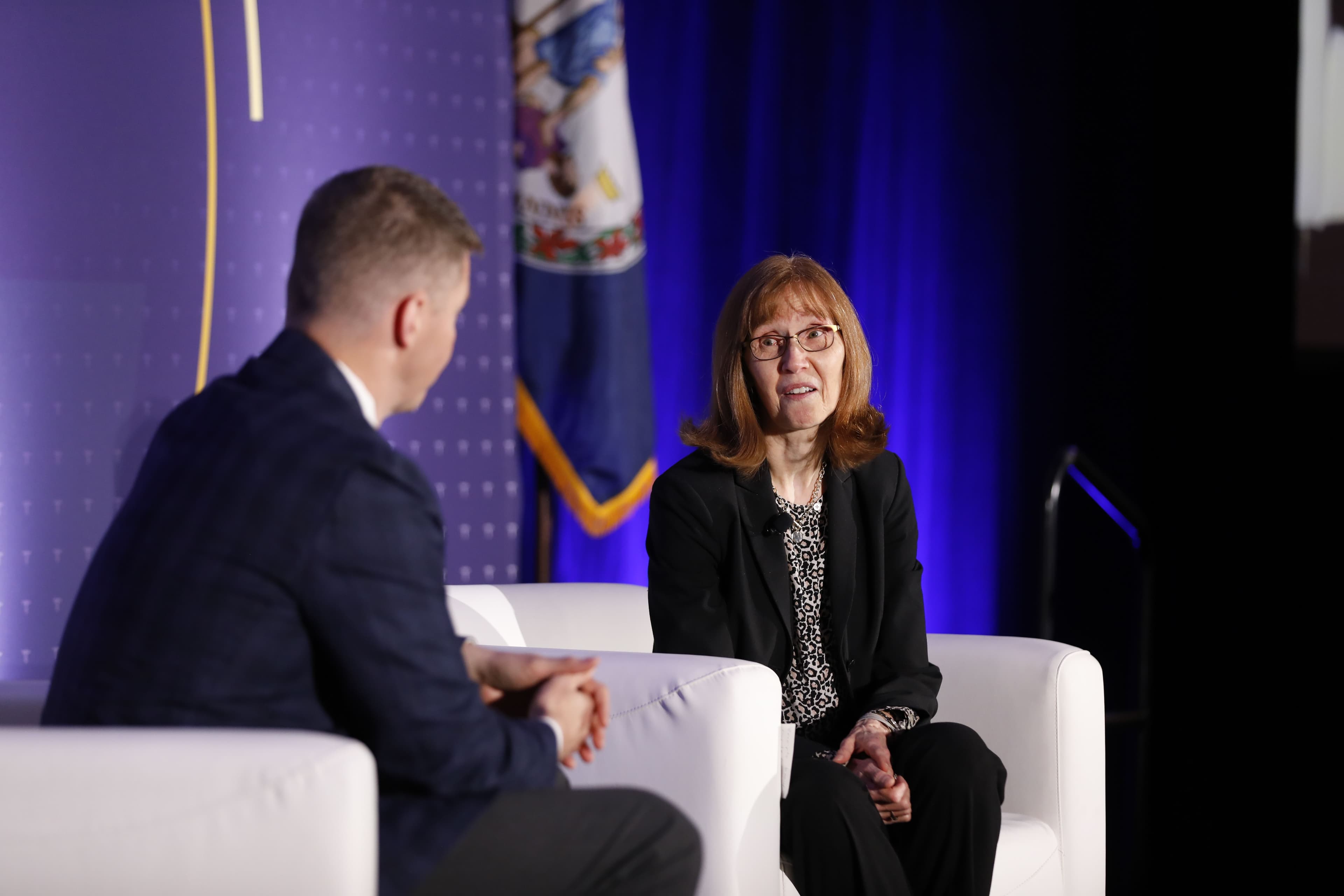
Julie Batchelor, Executive Director of Endpoint Technology for USPS, on stage at FedCyber Exchange.
5. Success encompasses people and performance, as well as tech
Julie Batchelor, Executive Director of Endpoint Technology at the U.S. Postal Service, brought a perspective that I don't always see: a federal technology leader who described how USPS delivered for their workforce a vision and technology investment that resulted in human impact. USPS isn't just a government agency, it's a 600,000-employee logistics network with 34,000 locations, 220,000 managed endpoints, and a legal obligation to serve every address in the country, including in rural and remote areas.
The USPS story is about what happens when you have a clear sense of mission and the operational discipline to align technology to it. Their journey with Tanium, from patch-and-deploy across constrained rural networks to reducing support calls with Tanium DEX and an active ServiceNow CMDB integration, is a model for how federal agencies can build layered, outcome-focused technology programs without sacrificing people or performance. Batchelor’s presence on stage was a reminder that the best federal IT leaders think about endpoints as the infrastructure that lets humans deliver services to other humans.
6. The energy around Autonomous IT is real, and the market is validating it
The momentum building around Tanium Autonomous IT felt different at this event. From Gartner Peer Insights ™ (12 new customer reviews came out of FedCyber Exchange alone) to IDC analysis to Forrester's Total Economic Impact study—which documented 235% ROI in just three years with payback in under six months, the external validation is stacking up. Tanium Autonomous IT is driven by AI and real-time endpoint intelligence, and what it delivers is specific: increased decision quality, compressed technology cycles across patch, software deployment, and remediation. The ability to stay resilient through continuous enforcement empowers IT and security teams to innovate faster, stay resilient, and move missions forward with confidence. That’s not theory, it’s what autonomous IT looks like in production, and agencies are seeing meaningful results, including*:
- 235% ROI documented by Forrester's Total Economic Impact study (March 2026)
- 75% reduction in Mean Time to Respond (MTTR)
- 95% improvement in workstation patching efficiency
7. ServiceNow + Tanium: Orchestration meets execution
Jonathan Alboum, Federal CTO at ServiceNow, joined Tanium Global ServiceNow CIO Saqib Khan for a fireside conversation that crystallized something I've been thinking about for a while: Real-time visibility isn't just a nice feature, it's now foundational to compliance, mission assurance, and risk management. The ServiceNow-Tanium relationship exemplifies what that means in practice.
“ServiceNow orchestrates. Tanium executes,” Alboum said. “Together, they deliver autonomous IT—where insight, decision, and action operate as one continuous system."
ServiceNow is exceptional at orchestrating process and workflow. It defines what should happen next, creating incidents, triggering change processes, prioritizing vulnerabilities, and coordinating response. What it doesn't natively do is execute those decisions directly on endpoints at scale, which is exactly what Tanium does. The closed loop—ServiceNow decides, Tanium executes, Tanium feeds results back—is what autonomous IT actually looks like in production.
For federal agencies already operating ServiceNow, adding Tanium isn't adding another tool; it's unlocking the value of their investment.
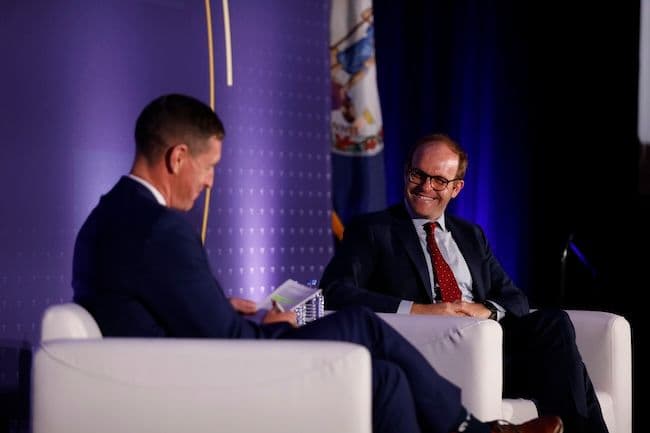
Nick Polk of OMB interviewed by Kyle Dewar at FedCyber Exchange 2026.
8. Risk as an operational discipline is a strategic advantage
Nick Polk, from the Office of Management and Budget, detailed how federal cybersecurity has moved beyond defining intent and into the harder work of sustaining execution. Strategy is largely set. The challenge now is translating policy into practical, repeatable implementation that delivers lasting risk reduction.
That means aligning Zero Trust, continuous authorization, AI governance, and digital modernization into a single execution model where policy, architecture, and operations reinforce one another. Treating risk as a continuous operational discipline, rather than a periodic compliance exercise, is what allows agencies to integrate innovation responsibly while maintaining trust, accountability, and mission continuity. Durable progress comes not from launching new initiatives, but from institutionalizing execution that scales across agencies and endures through change.
"We're at an inflection point," Polk said. "Our leadership has taken a step away from focusing primarily on compliance to ensure investments that lead to greater cybersecurity outcomes."
What Polk's perspective underscored is that agencies treating compliance as a periodic exercise are going to struggle. The ones building compliance into operational threat-informed workflows that leverage automation are building a strategic advantage. These agencies are faster, more credible, and less exposed to the gaps that emerge in real-time. Cyber resilience is the new competitive edge. Durable execution is now.
9. Efficiency isn't a budget conversation anymore, it's a mission requirement
The financial pressure on federal agencies is real and getting more acute. Budget constraints, workforce pressures, and the expectation to modernize without adding cost are converging in ways that are forcing hard decisions about tool consolidation, automation investment, and operational prioritization. I heard this theme across multiple conversations at this year’s event, and it wasn't abstract.
The agencies that are finding this path forward are the ones using platforms like Tanium to rationalize their tool landscape by replacing legacy solutions, automating patch and software delivery across constrained networks, and generating the kind of measurable ROI data that can justify continued investment. Federal agencies using Tanium have documented significant cost savings through unused software license recovery. This is a playbook, not a footnote. Doing more with less is now a mandate, and the technology exists to meet it.
10. The future is autonomous, and the architecture is being built right now
The Tanium roadmap shared by Matt Quinn, Tanium’s Chief Operating Officer, and Harman Kaur, Tanium's Chief Technology Officer, at FedCyber Exchange 2026 wasn't science fiction, it was a credible, near-term picture of where the Tanium platform is heading: AI-powered agentic workflows, predictive intelligence, Atlas's operational transformation, and the distributed architecture needed to serve the most complex federal environments at scale.**
<blockquote>Who is capable of autonomous IT and who isn't will become the defining variable in federal cybersecurity outcomes over the next five years.</blockquote>
Organizations that start building toward autonomous IT today, by establishing a real-time endpoint data foundation, maturing automation governance, and investing in operator capability, will be the ones operating with confidence when the next threat landscape shift arrives. Who is capable of autonomous IT and who isn't will become the defining variable in federal cybersecurity outcomes over the next five years.
“The future is autonomous,” Quinn said. “The only question is whether you’re building toward it deliberately or arriving there by accident—and those two paths lead to very different places.”
Final thoughts
FedCyber Exchange 2026 brought together forward-thinking people who are serious about protecting missions, managing complexity, and building organizations that can operate confidently under pressure. The conversations, about AI, resilience, compliance, efficiency, and the architecture of autonomous operations, reflected an industry that has moved past debating concepts and into the harder work of execution.
Streetman’s opening remarks reflected that outlook and how Tanium's work in the federal space goes beyond technology. He said, “We focus on advancing critical missions, and it's an honor to support your work protecting our national security, our infrastructure, and the people you serve.”
I agree, and Tanium's role in that work is clearer than ever. With real-time endpoint intelligence and control, Tanium Autonomous IT empowers security and IT teams to innovate faster, stay resilient, and move their missions forward with confidence. This year's event showed that agencies aren’t waiting, they’re building toward it now.
* Source: Forrester The Total Economic Impact™ Of Tanium Autonomous IT, March 2026. A commissioned study conducted by Forrester Consulting on behalf of Tanium. Results are for a composite organization based on interviewed customers.
** Tanium’s statements and content regarding its plans, directions, and intent are confidential and subject to change without notice at Tanium’s sole discretion. Information regarding potential future products or functionality is intended to outline Tanium’s general product direction and it should not be relied on in making a purchasing decision, nor is it incorporated into any contract. It is not a commitment, promise, or legal obligation. The development, release, and timing of any future products or functionality remain at Tanium’s sole discretion.