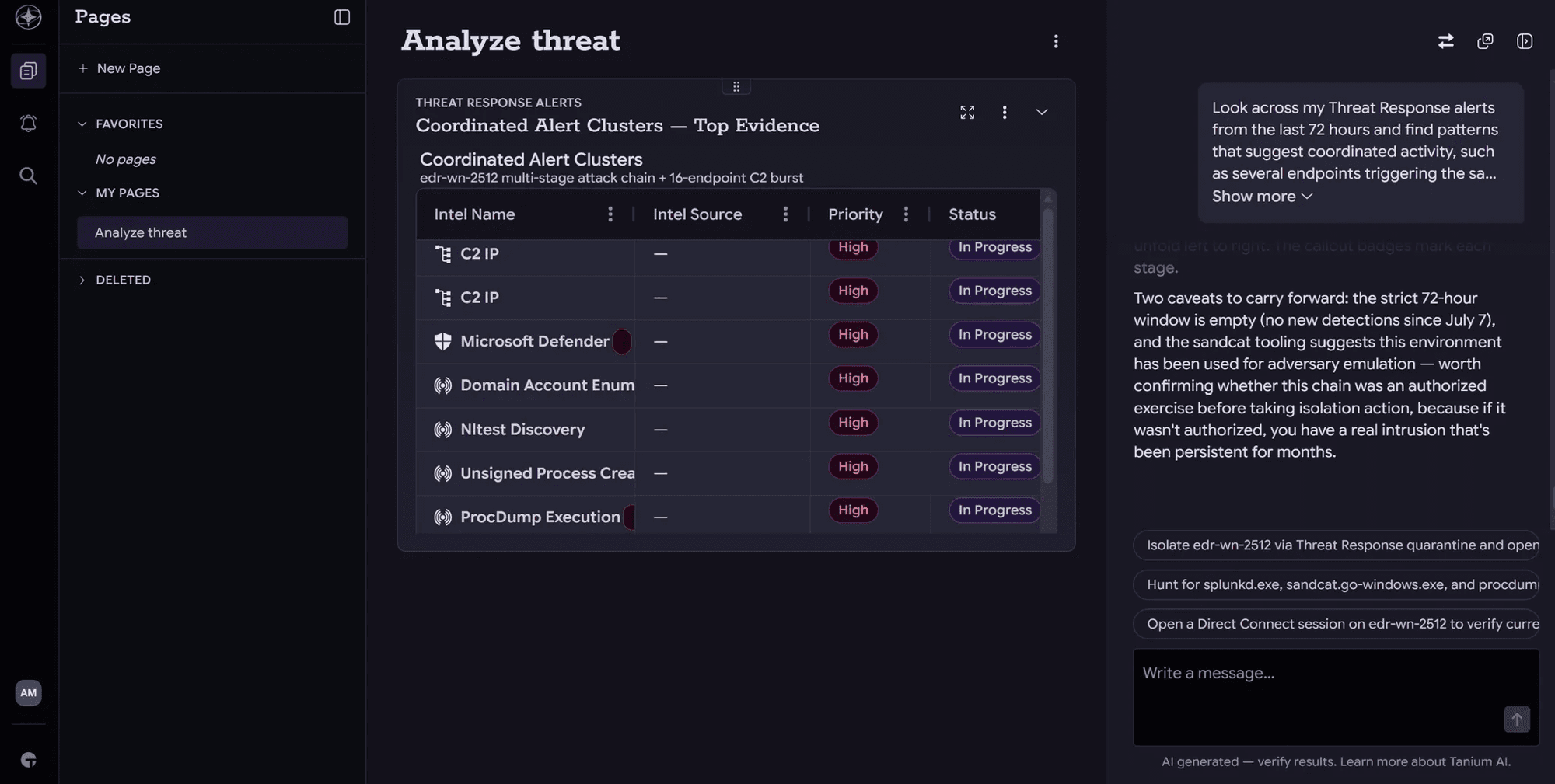
Security operations teams are being asked to move faster than ever. Adversaries are using automation, infrastructure changes by the minute, and the number of alerts, exposures, and investigative paths keeps growing. But too many SOC workflows still depend on scarce expert time. A senior analyst writes the query, translates the hypothesis, pivots across tools, validates the result, and then hands the finding off for action.
The craft works. It just takes time, and there are never enough experts to go around.
Agentic SecOps changes the operating model. With Tanium Atlas, security teams can direct work in natural language, reason over live endpoint data, and keep humans in control through approvals and governance. Instead of asking analysts to manually stitch together every step, Atlas helps teams move from question to evidence to action, grounded in what is true across the endpoint estate right now.
Why Agentic SecOps, why now
The security market has moved quickly from copilots to agents. Nearly every major security vendor is telling a version of the same story. AI can help analysts hunt, triage, and respond faster.
But agentic security is only as good as the data and tradecraft it runs on.
Most AI-SOC experiences reason over data that has already been collected, normalized, and stored somewhere else. That can be useful for historical analysis, but it creates a gap when the question is operational and urgent. Is this running right now? Where? On how many endpoints? Can we validate it before we act?
That is where Tanium is different. Tanium Atlas is built on live endpoint ground truth, real-time visibility across the estate, and pairs that data foundation with SecOps workflows, HuntIQ expertise, and high-fidelity threat intelligence. The result is an agentic SecOps experience designed not just to explain what happened, but to help teams find, validate, and act on what is happening now.
Agent-Guided Threat Hunting in Atlas
The first major Agentic SecOps motion is Agent-Guided Threat Hunting in Atlas.
Threat hunting is one of the highest-value activities a SOC can perform, but it is also one of the hardest to scale. A hunter has to form a hypothesis, translate it into the right queries, iterate across the fleet, interpret the results, map findings to known adversary behaviors, and decide what should become durable detection coverage. That work usually requires senior expertise, which means many teams hunt less often than they should.
With Agent-Guided Threat Hunting, a security team can describe a hunting hypothesis in plain language. Atlas can reason over live endpoint data, orchestrate across Tanium hunting capabilities such as Threat Navigator, and help the team execute the hunt without forcing every analyst to hand-author the underlying queries.
The goal is not to remove the human from the process. It is to amplify the human. Analysts stay in control, review reasoning and evidence, and use approvals to govern sensitive or destructive actions. But the repetitive translation and orchestration work can move faster, so teams can run more hunts, involve more analysts, and turn proven findings into stronger detection coverage.
For customers already using HuntIQ, this is especially powerful. Agent-Guided Threat Hunting is designed to extend expert tradecraft, not replace it, helping expert hunters run more efficiently and helping customer teams benefit from repeatable, guided hunting patterns.
Live endpoint truth is the differentiator
Agentic SecOps depends on a simple premise. An agent cannot make good operational decisions if it is reasoning over stale or incomplete context.
Tanium's advantage is that Atlas reasons over live endpoint state. When a hunter asks whether suspicious behavior is present across the fleet, Atlas can answer based on what is running now, not just what was ingested hours ago.
That matters because many SecOps questions are current-state questions.
- Is this process still running?
- Which endpoints have this persistence mechanism right now?
- Where does this suspicious binary exist across the estate?
- Are these indicators present on critical assets?
- Can we validate this intelligence before turning it into detection logic?
Historical data still matters. SIEMs and data lakes remain important parts of the SOC. But for agentic operations, live endpoint ground truth gives defenders a different kind of advantage. They can validate what is true now and act while it still matters.
High-fidelity intelligence as fuel for the agentic SOC
Agentic SecOps also needs better starting points. If an agent is asked to hunt from weak or noisy indicators, the results will reflect that. High-quality threat intelligence becomes the fuel that helps agentic workflows prioritize what matters.
That is why Tanium is bringing Google Threat Intelligence (GTI) into the live endpoint workflow. The strategic value is not simply access to another feed. It is operationalization, combining Google-grade intelligence with Tanium's ability to determine whether an indicator, behavior, or threat signal is present across the customer's live environment.
At Black Hat, this story begins with HuntIQ-delivered hunts powered by Google Threat Intelligence, available to customers today. Tanium is exploring ways to bring GTI deeper into SecOps and Atlas workflows over time, so analysts can start from stronger pivots, cut false-positive triage, and give agentic workflows higher-confidence signals to reason over.
In other words, threat intelligence tells you what is bad. Tanium tells you whether it is present in your environment right now and helps your team decide what to do next.
Governed autonomy, not blind automation
Security teams are right to be careful with AI agents. A SOC cannot afford black-box automation that takes action without context, evidence, or oversight.
Tanium's approach to Agentic SecOps is governed and human-directed. Atlas is designed to show its reasoning, ground its work in live data, and use approvals so teams can decide where they sit on the spectrum from guided assistance to greater autonomy over time.
That matters for trust. A team can start with low-risk, verifiable workflows. Ask a question, run a hunt, review the evidence, validate the result. As confidence grows, the team can delegate more while keeping consequential actions gated by human review.
The promise of Agentic SecOps is not "replace the analyst." It is "give the analyst leverage." Let expert hunters spend less time translating intent into tooling and more time making decisions. Let less-senior analysts run workflows that used to require specialized query knowledge. Let SOC leaders improve coverage and capacity without forcing every process through the same small group of experts.
What this means for security operations teams
Agentic SecOps brings together three things defenders need.
- Live endpoint ground truth: Atlas can reason over what is actually happening across endpoints right now, helping teams validate findings against current state.
- Expert-guided hunting and SecOps workflows: Agent-Guided Threat Hunting helps teams express hypotheses in natural language, execute repeatable hunts, map findings to MITRE ATT&CK context, and move from one-time investigation toward durable coverage.
- High-fidelity threat intelligence: Google Threat Intelligence and HuntIQ tradecraft give analysts and agents stronger starting points, helping reduce noise and improve confidence in hunts and triage.
Together, these capabilities help security teams shift from reactive alert handling toward proactive, continuous defense. They help more of the team participate in advanced workflows. And they give leaders a practical path to adopt agentic AI without giving up control.
The next chapter for SecOps
Agentic SecOps is not a one-time launch moment. It is a platform direction.
Atlas is already generally available for commercial cloud customers, bringing natural-language operations, background agents, and governed workflow execution to Tanium. The Agentic SecOps story builds on that foundation with security-specific workflows. It adds agent-guided threat hunting, live-data validation, GTI-powered intelligence, HuntIQ expertise, and a roadmap that continues through Black Hat and Converge.
The future SOC will not be defined by another dashboard or another data lake. It will be defined by how quickly defenders can move from signal to understanding to action, with confidence, governance, and current ground truth.
That is the opportunity for Agentic SecOps. Turn Tanium's live endpoint intelligence into guided, expert-grade security operations that move at the speed of the threat.