
Most organizations still run IT and security on tickets, dashboards, and scheduled patch cycles. For years, that was good enough. The problem is that the environment changed. Assets are constantly shifting. Identities are no longer just human. AI systems are making decisions in real time. And attackers are adapting just as quickly. What used to be fast enough is now already too late.
If you’re still waiting for a ticket, an alert, or a scan result to tell you something is wrong, the problem has already moved. That’s the gap organizations are feeling right now. Not a lack of tools, but a mismatch between how fast the environment moves and how IT and security are designed to respond. Closing that gap requires more than faster reactions. It requires a different operating model.
We have more and more AI agents acting within our ecosystems, granted varying levels of authority and autonomy. We have sprawling endpoint estates in constant flux. And we have agentic AI on the attack side as well, adapting to exploit vulnerabilities faster than even automated systems, with their human-defined parameters, can keep up.
The end state of IT, from both an operations and cybersecurity perspective, has to be Autonomous IT.
Autonomous IT is an operating model in which systems understand outcomes, validate their state, and take action without always waiting for human intervention. This is not about just automating the service desk with AI agents that can clear tickets faster. It’s a fairly new concept only recently within reach, and it moves beyond static automation by enabling IT and security environments to self‑diagnose, self‑repair, and improve over time based on trusted, real‑time intelligence.
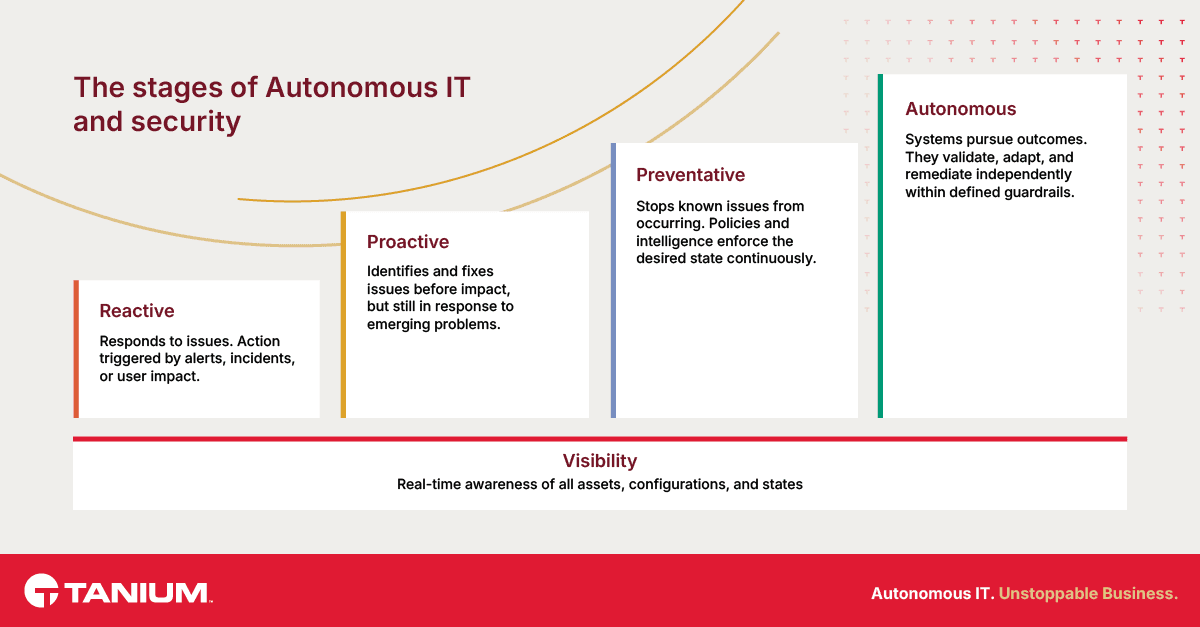
This unprecedented agency is a necessary evolution and starts with visibility at its foundation. It moves through reactive, proactive, and preventative states to shift emphasis from reacting to what’s broken to preventing the breakage. But preventing the problems you can foresee isn’t enough, because AI systems are much less predictable than traditional IT environments. To meet the new era, both cybersecurity and IT teams have to evolve, not just from human response to human-guided automation, but to systems that manage themselves.
Visibility: The baseline challenge of asset management
The foundational question of every cybersecurity and IT operations program is: What is it that I’m managing? You have to know what you’re managing before you can secure it. The challenge is silos—created not just by technology, but by process and people. When I was in IT Ops, for instance, my scope of work was applications. Our team built the packages, and we focused on getting the application right. The endpoints they ran on were owned by a different team, so our visibility into that layer was limited.
Everyone was doing their job. The problem was that the jobs didn't line up. So over the years, silos developed because different teams were not working in concert. And the lack of centralized approach or single source of truth drives the creation of ad hoc workarounds, rogue spreadsheets, and duct-taped solutions.
That’s the inventory challenge, but the problem is about more than getting every device onto one list. People approach an asset inventory the way you might count the contents of your fridge. But assets aren’t static like a jar of mustard—they’re very dynamic. They have a lifecycle that starts with procurement. You have a device that’s provisioned in a certain baseline way, and over time the user may request other applications or privileges. Users may change some configurations or load some unapproved software on their own. And then, at the end, you need a process to decommission assets at their end of life.
<blockquote>Visibility is about real-time awareness of three things: your full inventory of assets, their configurations, and their current state.</blockquote>
When an organization does try to work with all its endpoints holistically, it often finds that it can’t. Say that the security org wants to put EDR on every endpoint. They go to IT Ops to look at the change management database and the asset inventory—which is not in real time, and therefore is out of date. That lack of visibility undercuts basic processes like patching, and it severely impairs incident response.
That’s because visibility is about real-time awareness of three things: your full inventory of assets, their configurations, and their current state. Beyond the inventory, configurations tell you how things are intended to run, and a view of the current state shows you the reality. The gap between the two is where risk lives.
From reactive to autonomous in four stages
With visibility as a fundamental starting point, organizations can benchmark and improve their posture around asset management, governance, and cybersecurity. In this new AI era, there are four phases of IT and cybersecurity, with the ultimate stage, autonomy, incorporating AI to create self-managing systems that function at machine speed, and with machine insight, rather than on a human scale.
The four stages are:
- Reactive. With visibility as a foundation, you enter the first stage: Basically, when you realize something is broken or that an incident is occurring, you go fix it. You’re waiting for an alert or a ticket. Modern tools shrink response times from days to minutes to seconds, letting teams move so fast that it can feel proactive. But they’re still waiting to find out what’s broken, reacting to an event that has already occurred. At the rate that incidents happen today, that’s just not sustainable.
- Proactive. Here we start to see a shift. We’re not waiting for a problem to surface before taking action. The system detects the issue first and fixes it while it’s still small. You catch the performance degradation, the misconfiguration, or the drift before it turns into an outage or a ticket. But proactive is not prevention. You’re still dealing with problems; you’re just dealing with them earlier and with more context.
- Preventative. This is the step that gets us fully out of the reactive mindset. Now intelligence and policy stop the issue from happening at all. You’re not proactively fixing a problem before it has business impact; you’re making sure that the problem never exists. That only works when you understand patterns well enough to enforce the right behavior continuously, not on a schedule and not after the fact. The shortcoming is that you can only prevent potential problems that you know about. You have to predict the snafu and establish the means to detect and remediate it.
- Autonomous. Now things fundamentally change. Instead of humans defining every step, every decision tree, every “if this, then that,” you give an AI-driven system a goal and guardrails and it learns how to get to a solution. The assets know how they’re supposed to behave, and they can validate and correct themselves—sometimes by reporting an issue, sometimes by fixing it outright, and all in an auditable way. This shifts humans out of constant triage and into oversight, policy, and exception handling.
<blockquote>Autonomous IT shifts humans out of constant triage and into oversight, policy, and exception handling.</blockquote>
A core benefit of autonomy is that when something goes wrong and gets fixed, the insight propagates across the environment rather than disappearing into one field in an incident report or one system engineer’s head. The system gets better over time. That’s the difference between automation and autonomy: Automation follows instructions. Autonomy pursues outcomes.
Autonomy is essential in the age of AI
The scale, speed, and dynamism of modern IT environments have reached a point where humans simply cannot keep up. In an AI-driven world, maturity is no longer defined by how well people follow processes or how quickly teams can respond. It is defined by whether systems can understand their environment, validate their own condition, and act in real time.
This vision does not produce an all-automation world. Humans will still be setting goals, providing context, defining acceptable risk, and considering the ethical implications of a practice or a risk. Machines will excel at what they do so much better than us: repetitive validation, instantaneous remediation, and learning at scale—from every outcome across an entire fleet.
This is the shift from reacting to problems to preventing them, and ultimately to systems that can manage themselves within defined guardrails. Visibility is the foundation. Without it, nothing else works. From there, the goal is not to build faster humans.
It is to build systems that no longer need to wait on them.