Artificial intelligence is now embedded across enterprise environments—not just cloud services and consumer apps. It is showing up across enterprise environments in ways that traditional asset visibility tools were never designed to detect. MCP servers, local model managers, agentic frameworks, and local model files can all be present on endpoints without appearing in a standard installed applications list.
For CISOs and technical leaders, that gap represents a rapidly expanding attack surface that most organizations are only beginning to understand.
The new Tanium Guardian AI dashboard was built specifically to close that gap, giving security teams a structured, categorized view of AI tooling across their IT estate.
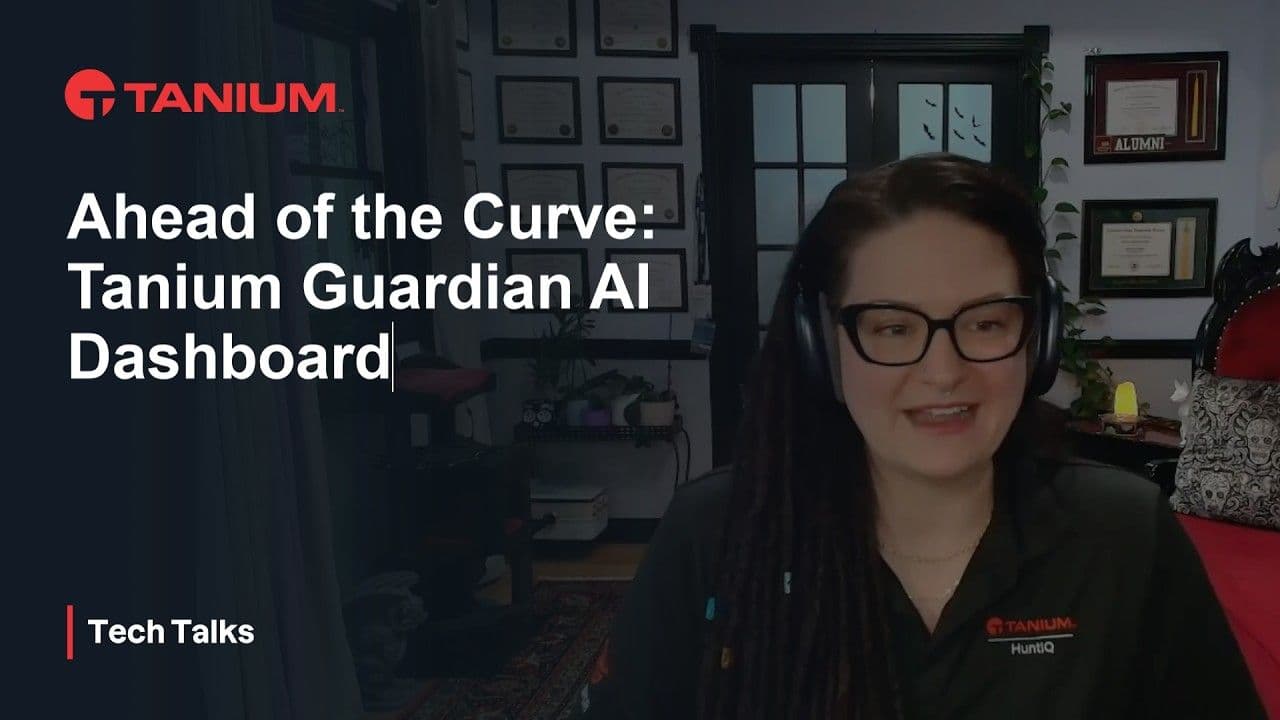
Melissa leads Tanium's Security and Product Design Research team, which is responsible for building all Guardian content in the Tanium Console. Tyler brings a background in threat hunting and incident response, including work with the United States Air Force, and played a key role in shaping the AI dashboard. Together, they explain not only what the dashboard surfaces, but why each category of AI tooling presents a distinct set of risks that warrants its own governance conversation.
This episode covers four specific categories of AI visibility: MCP servers and the access they can grant to local resources, local model managers and the performance and compliance risks they introduce, OpenClaw and its exposure to malware-laden skills and remote code execution vulnerabilities, and local model files and how to audit what models are actually running in your environment.
If your organization is trying to answer the question "Where is AI in my environment, and what is it doing?", this is the episode you need to watch. Start with the embedded video below.
Key takeaways
- AI visibility requires a new approach: AI can show up in environments in different ways—as part of certain tools, as agentic frameworks, as MCP servers, or as LLMs—so traditional asset visibility that produces a list of installed applications is not sufficient to surface all of it. Tanium built brand new sensors to help harvest this data and show you the different categories.
- Four distinct risk categories: The Guardian AI dashboard covers four major categories: MCP servers, local model managers (also called inference engines), OpenClaw, and local model files. Each presents different risk exposure and warrants a dedicated conversation about governance, even though they all fall under the AI umbrella.
“While [AI] is a great power multiplier, like I talk about it as a force multiplier for your teams and what they can do, it can also rapidly increase your attack surface. And I think a lot of people are struggling to understand which parts of the AI landscape scare them and which ones they actually need to be really focusing on.”Tanium Senior Director of Security and Product Design Research Melissa Bischoping
- MCP servers as entry points: Model context protocol servers are applications that can run locally and allow an LLM, including cloud-hosted ones, to interface with and access local data or resources. The dashboard surfaces MCP servers configured within common integrated development environments such as Visual Studio Code and Claude Code, at both the per-user and per-repository level, and identifies whether the communication type (HTTP or SSE) indicates a remote resource.
“No, it's not necessarily the same as blowing off the front of your house, but you are creating an entry point. So when you're looking atthis information, you need to be saying, "Do I recognize these MCP servers? Does this make sense in my environment? Is this something I know and have already got anexplicit policy around using?"”Tanium Senior Director of Security and Product Design Research Melissa Bischoping
- Local model managers introduce multiple risks: Inference engines, the software required to run an AI locally, can be installed as standalone applications, containers, Python packages, or Linux app image files, and some do not appear in a standard package manager. Beyond data exposure risks, local model managers can cause significant performance degradation on endpoints and servers, and the memory these models write to disk can retain sensitive data that may be subject to regulations like GDPR.
- OpenClaw combines agentic capability with serious security gaps: OpenClaw (previously known as ClaudeBot) allows users to interact with LLMs and external services through messaging platforms using components called skills and plugins. Some skills have been found to ship with malware, and researchers have identified a CVSS 8.8 remote code execution vulnerability with approximately 30,000 internet-exposed instances reported. The dashboard provides both running indicators and at-rest indicators, including running processes, containers, and file evidence on disk, to detect OpenClaw across its various versions and states of activity.
“We've opened the Pandora's box. We can't take it back, so let's plan accordingly.”Tanium Senior Director of Security and Product Design Research Melissa Bischoping
- Local model file auditing by extension: The dashboard surfaces local model files based on common file extensions, including .gguf, .safetensors, ZML model, and .onnx, providing the file name and path so teams can identify what models are running in their environment. This matters because the quality and origin of a model affects output accuracy, and some models carry security concerns related to their origin or licensing. This section requires Tanium Threat Response with Tanium Index.
- Executive summaries via Tanium Ask: The dashboard includes a summarize button powered by Tanium Ask that generates a contextualized, bullet-point executive summary of the AI visibility data. This allows security leaders to quickly communicate findings, such as the number of configured MCP servers in the environment, to executive stakeholders without them having to scroll down the whole page.
Additional resources
- Tanium Guardian—AI and security content for endpoint visibility: Learn how Tanium Guardian delivers curated security content, including the AI dashboard covered in this episode, directly within the Tanium Console.
- Claude Mythos security risks—what the Anthropic System Card tells us: Examine what the Claude Mythos system card reveals about rapid advances in AI‑driven exploit development, collapsing disclosure‑to‑exploitation timelines, and the implications for vulnerability management, patching cadence, and defensive strategy in the AI era.
- How shadow AI is showing up in enterprise environments—and what your security team needs to know: Explore how unsanctioned AI tools are proliferating across IT estates and why visibility into shadow AI has become a critical security priority.
- Ultimate Guide to AI Cybersecurity—benefits, risks, and rewards: Get a comprehensive overview of how AI is reshaping cybersecurity—from faster threat detection and response to emerging risks, regulatory concerns, and real‑world limitations—so security leaders can make more informed decisions about adopting AI in their security operations.
- How Tanium Guardian surfaces real-time risk: See how Guardian dashboards give security teams immediate visibility and one‑click action against emerging vulnerabilities and abused remote access tools.