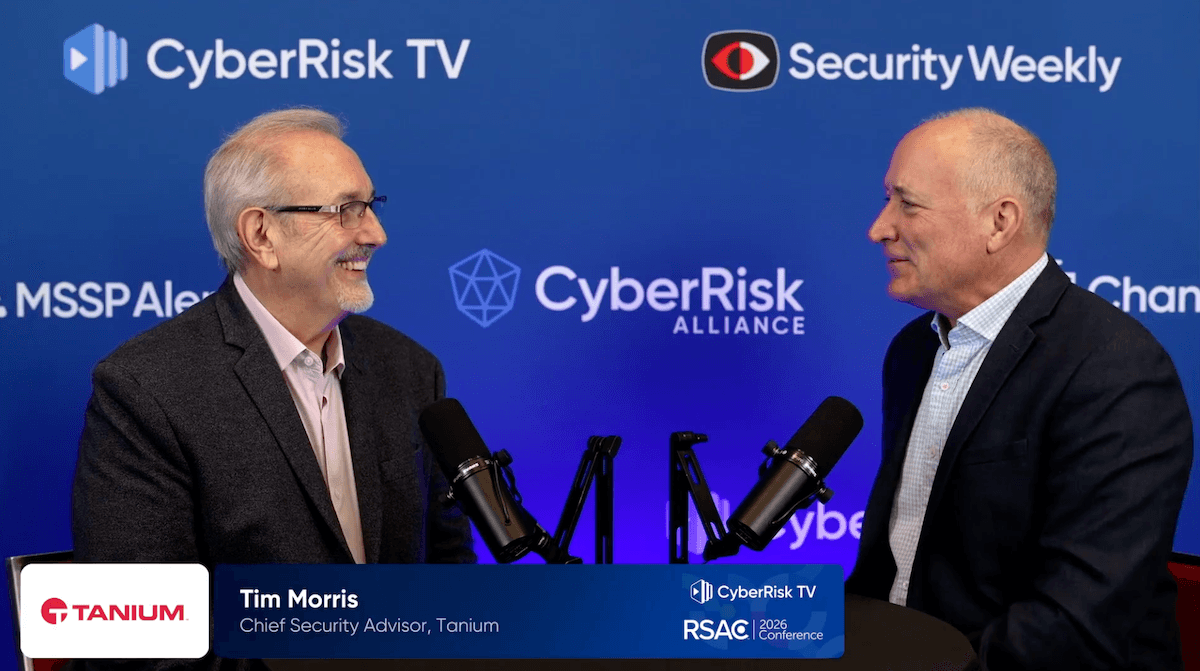
The security industry is converging on a shared ambition: autonomous operations that can detect, respond to, and remediate threats without constant human intervention. But as Tim explains at RSAC 2026, most organizations are attempting to skip a critical step.
Before any program can move from reactive to proactive to preventative to autonomous, it must first solve what he calls "step zero": visibility. Without real-time, trustworthy data about every endpoint in the environment, there is no foundation for what he describes as "trusted automation," and without trusted automation, the path to autonomous operations simply does not exist.
Tim draws on nearly two decades of experience with the Tanium platform, and a career spent managing malware outbreaks, incident response, and threat hunting, to explain why fragmented tools and stale data have kept organizations stuck in a reactive posture. He walks through how Tanium's distributed agent architecture was purpose-built to solve the hub-and-spoke problem that plagues conventional endpoint management, enabling environment-wide queries typically in seconds rather than a week. He also addresses how agentic AI integrations with platforms like Microsoft Defender and ServiceNow are now enabling the kind of cross-system orchestration that makes autonomous operations a realistic near-term goal.
If your organization is evaluating how to build a credible path toward autonomous Security Operations, or if you're still working through the foundational visibility problem that makes everything else more complex, this conversation delivers specific, grounded insight you won't want to miss. Watch the full video below.
Key takeaways
- Maturity precedes autonomy: Tim describes a clear progression from reactive to proactive to preventative to autonomous, and argues that organizations cannot skip stages—each level of maturity must be earned before the next becomes achievable.
- Visibility is step zero: Before any automation can be trusted, organizations must be able to trust their data. Tim identifies real-time visibility as the prerequisite for what he calls "trusted automation," which is itself the prerequisite for autonomous operations.
“If I can't trust the data, I can't trust the outcome.”Tanium Chief Security Advisor Tim Morris
- Fragmentation blocks progress: Because security, IT operations, and GRC teams cannot trust data from each other's systems, they build their own separate data pools, creating the fragmented, siloed environments that prevent any unified, mature program from taking hold.
- Architecture matters: distributed vs. hub-and-spoke: Tanium's founders deliberately moved away from the hub-and-spoke architecture that plagued earlier endpoint management tools, building a distributed agent model, inspired by a networking protocol originally designed for multiplayer games, that allows the platform to query an entire environment typically in seconds instead of days.
- Endpoints are intelligent, not dumb: Tim challenges the industry's tendency to treat endpoints like dumb terminals from the 70s or 80s. In reality, endpoints know their own state from cradle to grave and can feed that information to whatever orchestration system you have in real time.
- Built as an AI company from the start: Tim distinguishes Tanium from vendors that have simply added AI capabilities to existing products, arguing that the platform was architected for self-diagnosis and self-repair from its earliest days, almost 20 years ago.
“It [Tanium] was built as an AI company from the very beginning almost 20 years ago.”Tanium Chief Security Advisor Tim Morris
- Agentic AI enables cross-system orchestration: Strategic integrations with Microsoft Defender and ServiceNow's Now Assist agent are enabling Tanium to move beyond chatbots into true agentic orchestration, where the platform serves as the eyes, a workflow brain provides instructions, and Tanium's agents execute remediation as the hands and feet.
“When you can look at your entire environment and within 15 seconds know exactly where it's at and then immediately remediate, that's the difference.”Tanium Chief Security Advisor Tim Morris
Additional resources
- Tanium product releases and platform updates: Stay current on the latest Tanium platform enhancements, security improvements, and feature updates, including cloud and on‑premises releases that support the real‑time visibility and trusted automation foundation discussed in this conversation.
- What AI automation is—and why it changes how IT teams scale operations: A practical explanation of how AI‑driven automation differs from traditional rule‑based workflows, why learning systems require trusted, real‑time data, and what organizations should understand before applying AI automation across IT and security use cases.
- How agentic AI is reshaping security operations—and what teams need to know before scaling it: A deeper look at the agentic AI capabilities Tim describes in this conversation, including the pros, cons, and practical steps organizations need to take before deploying agentic AI in security operations.
- Tanium Automate—orchestrating and automating mission-critical IT workflows: Documentation covering Tanium Automate's playbook-based orchestration capabilities, directly relevant to the trusted automation foundation Tim describes as the prerequisite for autonomous operations.
- Autonomous IT operations: Transforming enterprise IT management: Watch Tanium CTO Matt Quinn at RSAC 2026 explain why real-time, endpoint-level decision-making is the foundation for autonomous IT—and how capabilities like Guardian AI Spotlight help enterprises govern AI use while scaling automation securely.