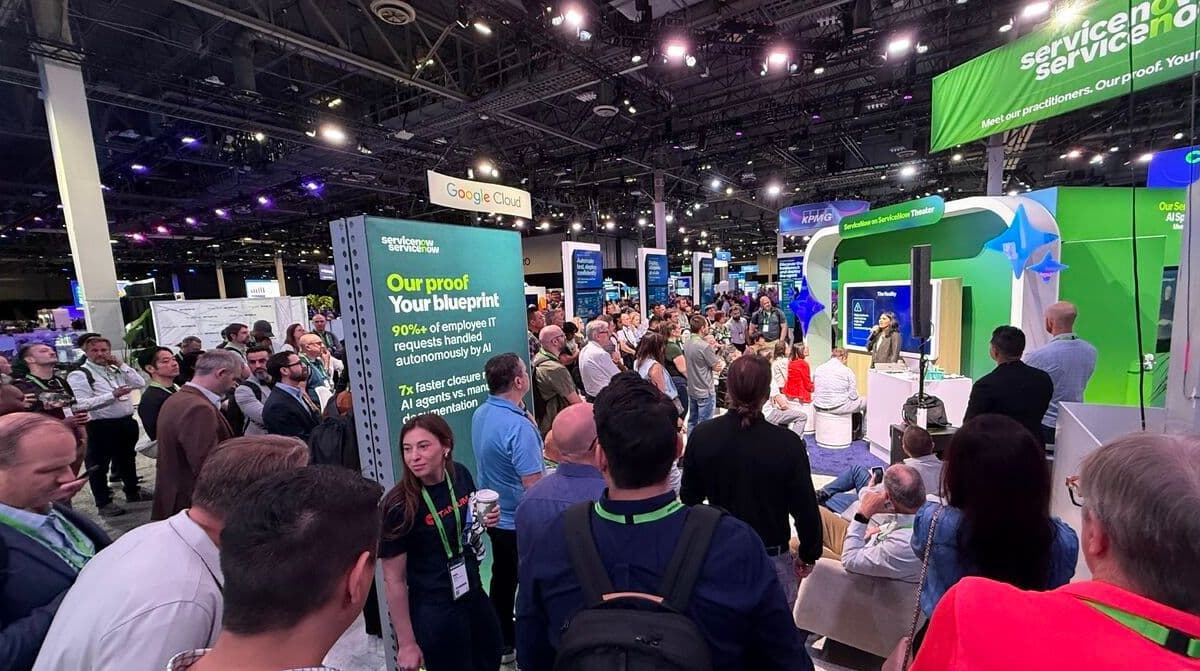
ServiceNow Knowledge 2026 brought tens of thousands of IT and security leaders to The Venetian in Las Vegas for three days of keynotes, sessions, and conversations about where enterprise technology is headed. The big focus was on AI agents and autonomous workflows, which have moved from aspiration to implementation, and the pressure on IT and security teams to keep pace.
Tanium was there as a Gold Sponsor, leading insightful sessions, including a real eye-opener with McDonald’s. And there were big product announcements, most notably ITOM AI Prime powered by Tanium—a first-of-its-kind joint offering that bundles ServiceNow ITOM AI Prime and Tanium, bringing real-time endpoint intelligence together with ServiceNow’s CMDB, AIOps, workflows, and AI. Tanium also unveiled Tanium Atlas, a new autonomous operating system that combines real-time endpoint intelligence across millions of devices with AI agents that operate continuously.
After the conference wrapped, we sat down with Saqib Khan, Tanium’s VP of Solution Architecture and the company’s Global ServiceNow CIO, who was a very visible presence at the show. We talked about what happened on stage and the energy in the room. Most importantly, we discussed how the sessions and announcements help organizations close the gap between insight and action to realize the promise of AI.
Q: The conference theme was “AI in three days. Impact for years.” What was the actual energy on the floor — what were people talking about, and what tensions were you picking up on?
Khan: Generally speaking, the energy was, “Wow, this is incredible,” in terms of the industry trends and all the AI capabilities ServiceNow was rolling out, especially around security and risk. But you could tell from [ServiceNow CEO] Bill McDermott’s opening that he wanted the audience to understand: Yes, there’s a lot of noise about AI’s impact on SaaS, and AI agents dominating and replacing software—but in reality, an explosion of AI agents requires a very controlled, governed ecosystem where everything is connected. IT, security, risk, CRM, HR—all of it. Business processes and outcomes, governed in the same system they operate in.
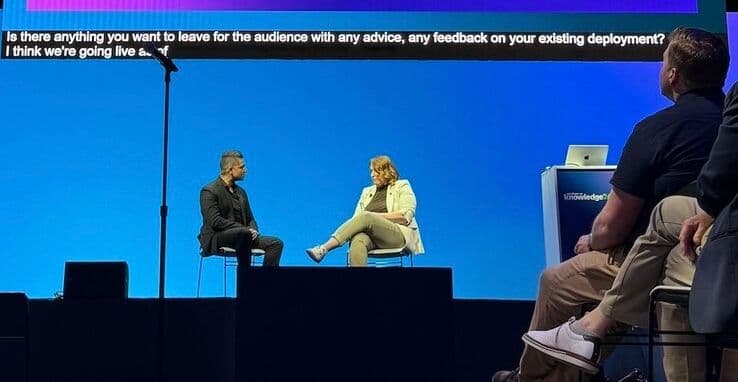
Khan and Tricia Rigel onstage for “The Autonomous State of the Restaurant.”
Q: The McDonald’s session, “The Autonomous State of the Restaurant,” was a marquee moment. You had Tricia Rigel, VP of Enterprise Products and Platforms, walk everyone through how McDonald’s manages nearly 50,000 restaurants across 105 countries, with over a million devices in their change management database. Where were the moments that really landed with the audience?
Khan: We designed that session to give people a reset. All this incredible AI capability was being unveiled, but the vast majority of the audience was still at step one, dealing with a core challenge: the foundational data problem. The CMDB.
Tricia’s story helped navigate the reality that AI struggles with its dependency on good data, and the challenges of scale. AI is running in the moment, helping you do things. But if that AI is powered by outdated business and technical data, you have to second-guess the outputs. An ice cream machine going down right now is a completely different problem for McDonald’s than a list of the ice cream machines that went down last week.
That’s where the session shifted from pure tech to the real-world outcomes. And I think a lot of people genuinely appreciated Tricia’s insights into why it’s so critical to get the foundation right the first time.
Q: You were also on stage for “Now on Now: Journey Toward Zero Controllable Incidents” with ServiceNow’s Madhuri Manikonda. What was the takeaway there?
Khan: “Now on Now” was about what good looks like when the foundation is in place. Here’s a program that can be running in your organization right now. I think it’s genuinely disruptive in the best way, because it surfaces the low-hanging fruit that’s right in front of you. Tasks we’ve been trying to automate for years with basic tools can now be handled by agents that operate faster, more accurately, and at greater scale.
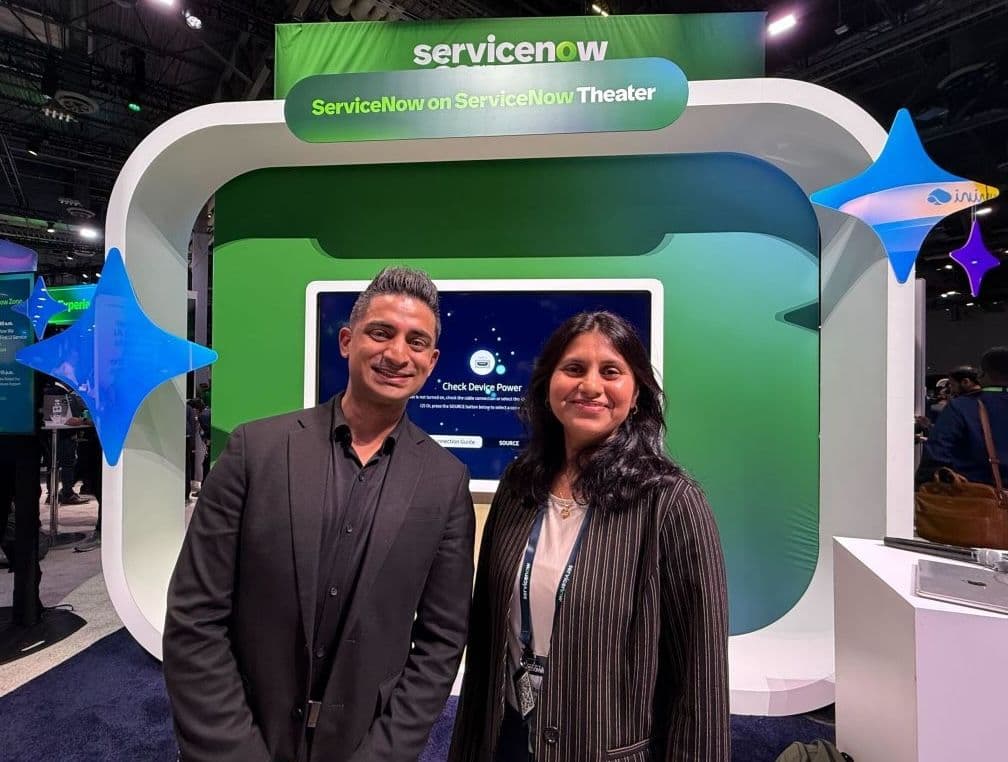
Khan and ServiceNow Senior Director of Digital Technology and AI Operations Madhuri Manikonda before their session.
ServiceNow wanted to set an example for the industry, and I think they did. It was more demo than discussion. Madhuri was able to show AI workers in ServiceNow supporting existing service desk and operational teams—operating with confidence because Tanium is embedded for verification, validation, and runtime intelligence. The results ServiceNow has seen internally speak for themselves: more than 60% improvement in mean time to resolution, meaningful deflection of incidents, and they’re live in production right now. In a complex, multi-threaded vendor environment that runs 24/7, that’s a true testament to what this platform can deliver.
Q: Let’s talk about the headline announcement: ITOM AI Prime powered by Tanium. ServiceNow has never done a joint offering like this with any other partner. What does this package bring to the customer?
Khan: It’s genuinely one of a kind, and it exists now because ServiceNow and Tanium deeply value what our partnership has built over the last five years. For customers, it reduces confusion. Conversations that used to be “Tanium discovers this, ServiceNow discovers that—which do I use?” now shift to: "Here’s how we solve this together, as one mission." And critically, the bundle isn’t just about wall-to-wall visibility—it’s about the ability to act on that visibility.
And on the AI side, this gives customers a clear, direct path to an autonomous service desk, with Tanium’s real-time endpoint intelligence powering the agents above it. It makes getting started much simpler.
Q: Tanium also announced Atlas at Knowledge 2026. Atlas transforms how organizations secure and optimize their endpoints, and allows every individual to operate faster and better. What is it, and how does it fit into the ServiceNow story?
Khan: Tanium Atlas is an AI-first experience that focuses on outcomes. It dynamically brings data, guidance and action together as a sort of one-stop-shop approach to Tanium.
Where Atlas fits in with ServiceNow, the most useful way is to imagine a ServiceNow autonomous agent that triages an incident and gives you an initial view of the root cause. With Atlas, the user can now spin up a workspace to bring all the data around the incident together and dive in using natural-language queries to get the complete picture. Users can also get recommendations for next steps. You're not switching contexts, you're moving from intent to outcome in a single, governed experience.
Q: Tanium and ServiceNow are both leaders in the concept of Autonomous IT. But most organizations haven’t really started that journey. They struggle with sprawling hybrid environments, surging vulnerabilities that overwhelm monthly patch cycles, and agentic AI being slathered on top of it all. So where do they actually start?
Khan: You start with defining the outcomes you want in the short and long term, and framing that through the lens of your specific industry. Retail, finance and healthcare each have a different set of AI outcomes that make sense. Within that, your specific organization has its own combination of requirements and constraints.
When you work back from those outcomes, you almost always arrive at the same blocker: lack of confidence in the data, and an inability to use that data to drive decisions through autonomous agents. So everyone comes back full circle to the CMDB. The CMDB and foundational data are the building blocks for everything you want to do.
For a practical entry point, start with the service desk. You get repeatable processes—resetting a password, imaging a machine—that don’t deviate much, and that directly benefit from automation. From there, you expand into more complex tasks and broader programs. The key is: industry, applied to your specific organization, then Tanium and ServiceNow providing the architecture to get there faster than you’d expect.
Q: What’s the biggest shift in how IT and security leaders are thinking that you took away from Knowledge 2026 — not the announcements, the actual change in mindset?
Khan: A few things. First, ServiceNow’s commitment to security and risk came through loud and clear. The investments and acquisitions they’re making are going to enable real security and risk automation and AI workflows in ways that weren’t possible before.
Second, there’s a growing understanding that a “headless” AI experience is coming, and it needs to be governed. Every organization wants to work in the AI tools and workflows that fit them—not everything lives inside one platform. ServiceNow data, actions, and orchestration will increasingly need to operate in a headless mode, serving AI chains and tools that live elsewhere, with an AI control tower governing what’s happening across all of it. That control tower was a real takeaway for a lot of attendees—the idea that the business should be centering its AI risk governance there, and that eventually it might autonomously mitigate risk on its own.
The broader message that I think landed with everyone: You have to control AI the right way for the business, understanding how technical risk becomes business risk. That mindset shift—from AI as a capability to AI as something that needs to be governed and trusted at every layer—felt like the most important thing people left with.
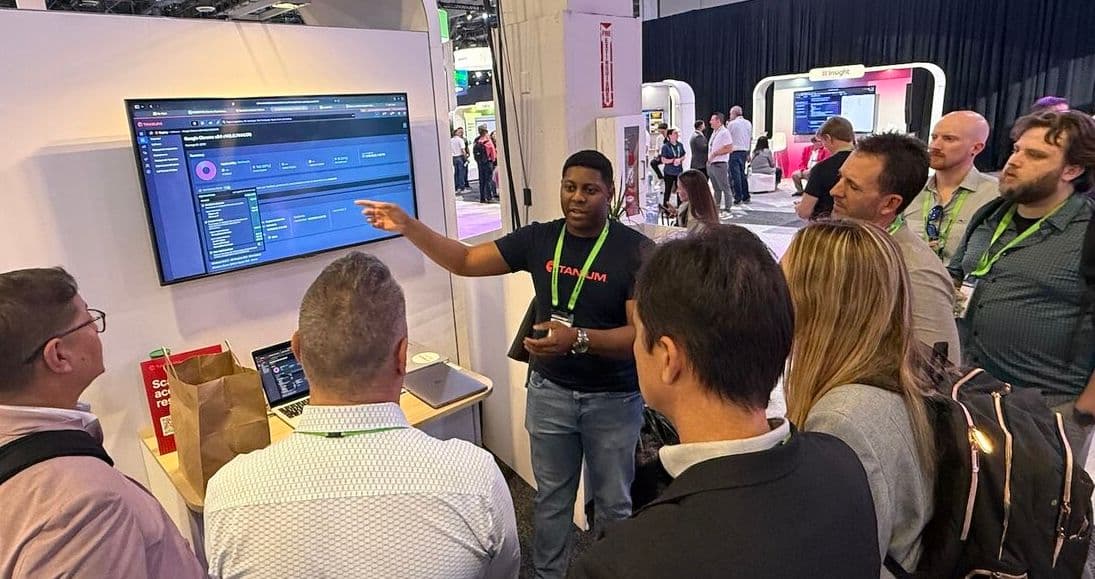
On the floor, Tanium experts demonstrated the power of the Tanium platform to attendees throughout the three-day event.
The big takeaways
As Khan makes clear, Knowledge 2026 had a lot of knowledge to impart. Attendees got a taste of the near-future of the AI-enabled enterprise, and insight into how industry leaders like ServiceNow and Tanium are opening up new possibilities. They also saw the gap between where most organizations are now and what’s already possible.
Attendees got a preview of a world where AI agents handle the repeatable work, CMDB data is trusted because it’s live, and IT teams can focus on the decisions that require human judgment. Tanium’s announcements—the ITOM AI Prime bundle with ServiceNow, the launch of Tanium Atlas—are the infrastructure for that future, built on a five-year partnership.
Tricia Rigel laid out how it gets done: Create trust with trusted, real-time data, and build one step at a time. That’s how every journey starts.